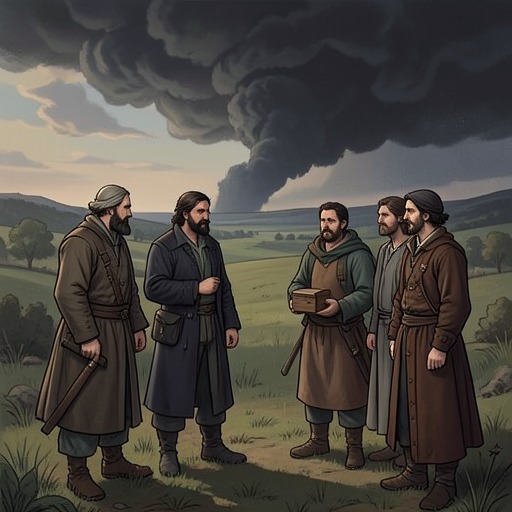
Charlie and Evie
Earth AbidesCharlie and Evie’s relationship turns a previously unspoken taboo into an open challenge to Ish’s authority and a test of The Tribe’s power to protect itself. The evidence shows an emerging intimacy, not a settled or fully explained partnership: Evie’s unusual attention to Charlie and her ease beside him are observed largely through Ish’s perspective, while Charlie makes his interest unmistakably public. Their connection forces the community to confront both its assumptions about Evie and the consequences of admitting a newcomer into a small, vulnerable society.
Background and First Signs
Evie had long been part of the younger members’ lives, but the group had treated her as someone outside ordinary courtship. Ezra had found her alone after the Great Disaster, living in severe neglect and able to feed herself by opening cans. Ish recalls that the group cared for her over many years, though he questions whether their care arose from affection or from a surviving humanitarian standard. His account is not a neutral description of Evie: it reveals how long familiarity and his assumptions have obscured her as an individual.
At the bonfire, Ish sees Evie seated close beside Charlie, among the younger people gathered to hear him talk. Her place in the group is striking because she would normally remain at its edge, watching events furtively. Now she keeps her attention on Charlie, apparently absorbed by his words even if she cannot follow much of what he says. Ish recognizes that her interest involves more than understanding the story, but what she feels is conveyed through his reading of her behavior rather than through an explanation from Evie herself.
The scene also changes Ish’s perception of Evie. He suddenly recognizes her as an adult woman, and notices her beauty, but his reaction remains constrained by the image of her that he has carried for years. Her unfamiliar eyes and what he regards as vacancy prevent him from seeing her without reservation. The episode therefore marks not only a change in their relationship but a belated shift in Ish’s view: Evie has not suddenly become an adult; Ish has newly apprehended what his habitual assumptions had kept him from seeing.
Public Intimacy and Open Conflict
The group’s response to Charlie makes the relationship visible as a social crisis. At one moment, Evie laughs at something he says, and Charlie’s familiar, playful manner toward her draws her into the exchange. When Ish approaches, everyone turns to him. He understands that the new situation has unsettled the others and that they expect him to decide what should happen. Charlie then puts an arm around Evie and draws her close. She looks surprised but settles beside him. In Ish’s eyes, the gesture turns their closeness into an unmistakable public defiance.
Ish orders the others away so he can speak with Charlie alone, asking Ezra to take Evie to Molly’s under the pretext that her hair needs combing. The group leaves without protest, but Ish knows that sending Ezra away also means giving up his strongest ally in front of Charlie. The detail reveals the precariousness of his position: he still acts as a leader, yet his authority cannot simply be reinforced by the presence of his most trusted associate.
Ish tells Charlie to stop pursuing Evie. Charlie asks why, and Ish answers that he fears Evie might have children whom he considers cognitively impaired, placing a burden on the community and, in his view, affecting its future. The argument exposes the social calculation Ish applies to their intimacy: he treats possible descendants as a collective risk before Evie’s own wishes or status have been established. Charlie challenges that reasoning, pointing out that Evie has lived among the young men for years without having children. Ish replies that she was taboo to them and that the boys married as early as they could.
Charlie turns that explanation against Ish. He presents his choice of Evie as a concession, noting that other young women might have been involved and that such a situation could have caused further trouble. Ish has no police, district attorney, or older legal order to invoke. He recognizes that by arguing rather than issuing an effective command, he has conceded that the command alone carries little force. He leaves the encounter knowing that Charlie has won that immediate contest of authority.
Evie’s Status and the Community’s Debate
The conflict does not end with Ish’s private confrontation. Molly has to lock Evie in an upstairs room, a measure that makes the intensity of the situation plain without resolving what Evie herself wants. The group’s concern is not limited to Ish’s prediction about children. They also have to decide whether Charlie’s presence and influence can be safely controlled, and whether their existing expectations about Evie should continue to govern her life.
Ish repeats his concern that Evie might have children with cognitive disabilities, but the argument carries less weight among the younger people than he expects. They have known Evie as part of their lives, and the possibility of children like her does not trouble them in the same way. George offers a different explanation for her condition: perhaps the trauma of being left alone as a child, after everyone around her had died, affected her development. He suggests that Evie might be as intelligent as anyone else and that her children might therefore be unaffected. Ish cannot accept this as certain, but recognizes that it makes an impression on the group. For some, Charlie begins to look less like a threat and more like someone who might bring Evie back into ordinary community life.
Ezra then supplies information that changes the stakes. After learning about Charlie personally, he reports that Charlie has sexually transmitted infections. The disclosure shocks the older members, including Ish, George, and Em, while the children do not understand its significance. The intimacy that began as a violation of an inherited taboo is now tied to a specific health concern. The text does not present the relationship as a private matter that the community can simply ignore; in a small population with few means of treatment or containment, personal contact has consequences for others.
Collective Protection and Later Consequences
The adults discuss the problem on the premise that The Tribe has a right and a duty to protect itself. A warning seems inadequate, and punishment after the fact would amount to social vengeance without preventing disease. They have no practical means to imprison Charlie, and an improvised jail would demand more supervision than the small community could sustain. They therefore consider banishment: Charlie could be taken away and told to leave, with death as the penalty if he returned. Even naming that possibility disturbs the group, which has not faced war or execution for a long time.
The relationship thus helps expose a larger weakness in the community’s earlier, informal order. Ish’s authority cannot substitute indefinitely for shared rules, especially when his objections are disputed and the danger is not merely a matter of obedience. The group must reason collectively about self-defense, enforcement, and the risks of leaving Charlie free to return or form alliances among the young. Their deliberation turns the intimate conflict into a question of common law and survival.
A later epidemic gives the community’s health fears a concrete context, although the evidence does not prove that Charlie and Evie’s relationship caused it. A week into the outbreak, Dick, who had accompanied Bob on an expedition, Ezra, and five children are ill; Ish believes the disease is typhoid. He later reasons that Charlie may have carried typhoid germs, since Charlie had eaten with two boys for more than a week and was careless about personal cleanliness. The text also identifies poorly constructed outhouses and flies as an obvious route for wider infection. The community boils drinking water, burns old latrines, fills the pits, and sprays the new latrines with DDT, but these measures come too late to prevent exposure. This later crisis sharpens the significance of the earlier dispute: in a society without dependable medical infrastructure, intimacy, sanitation, and community protection are inseparable concerns, even when the precise source of infection remains uncertain.